

AI Visibility Just Got a Rulebook. Here Is What It Means For Your Brand
Executive Summary
- In August 2026, the Interactive Advertising Bureau (IAB) released the Project Eidos framework, establishing the first global industry benchmark for measuring brand and publisher presence in AI responses.
- Traditional web traffic is declining as zero-click interactions rise. ChatGPT serves over 900 million weekly active users, while Google AI Overviews reach 2.5 billion monthly users.
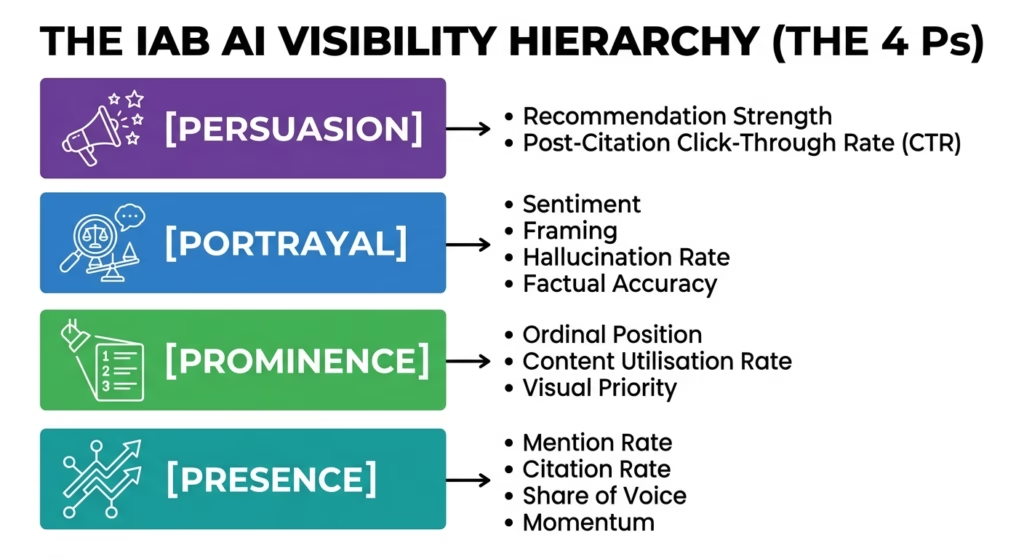
- The IAB standard organises visibility into a four-level causal hierarchy: Presence, Prominence, Portrayal, and Persuasion.
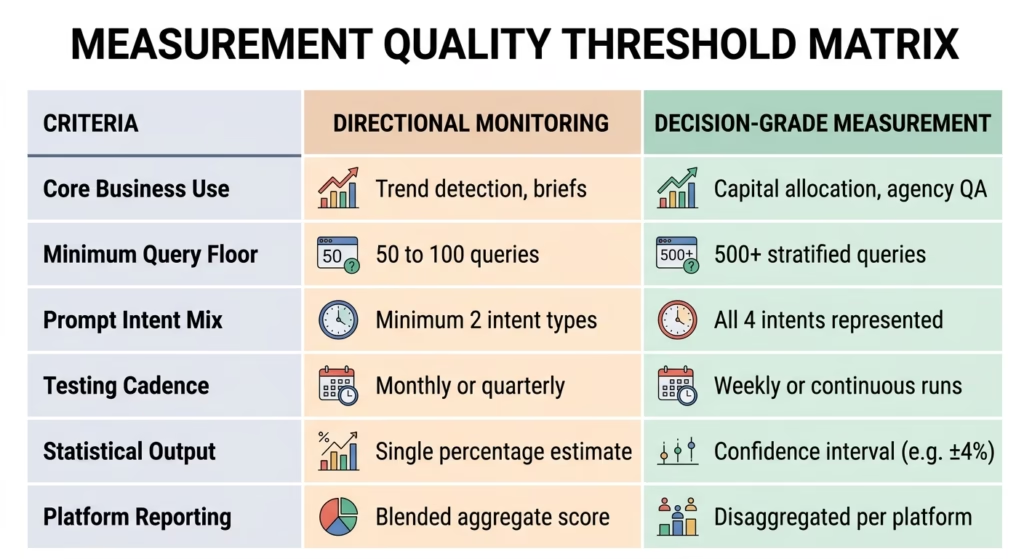
- Data must be classified into directional monitoring for general awareness or decision-grade measurement for capital allocation.
- European mid-market enterprises must unify their analytics through the IDIRA Framework and governed MCP infrastructure to protect brand accuracy, secure data sovereignty, and accelerate revenue.
Why AI Visibility Measurement Dictates Your Boardroom Strategy
If your brand remains invisible inside AI answer engines, your organic pipeline is silently bleeding. Consumer discovery has undergone a permanent structural change. ChatGPT now commands more than 900 million weekly active users. Google AI Overviews reach over 2.5 billion users monthly, appearing on nearly half of all queries and 14% of shopping searches. Research from McKinsey & Company indicates that brands unprepared for this transition risk losing 20% to 50% of their traditional search traffic.
Publishers face immediate consequences. Data from Chartbeat and Axios confirms that organic search referral traffic dropped 60% for small publishers, 47% for medium publishers, and 22% for large digital properties over the past two years. Chatbot referrals surged by over 200%, yet they still generate less than 1% of total page views. Volume is shrinking while zero-click answers take market share. According to SparkToro and Datos research, over 26% of desktop queries in the United States and 24% across the European Union end without a single click.
Despite this tectonic shift, only 16% of brands track their presence inside AI models systematically. CMOs and Chief Marketing Directors frequently report a lack of shared, reliable measurement standards. Budgets are assigned, agencies are evaluated, and strategic plans are presented based on inconsistent data that no CFO can independently audit. The industry required an objective baseline.
The Problem IAB Set Out to Solve
Over 20 vendors currently sell AI monitoring software. Each uses custom prompts, disparate collection methods, and proprietary scoring algorithms. Ask two different tools for your share of voice on OpenAI or Anthropic, and you will receive contradictory numbers. Neither vendor is necessarily lying; they are measuring completely different phenomena.
This operational disconnect carries serious financial risk. The CMO Alliance 2026 report reveals that CMO confidence in overall business strategy sits at 7.5 out of 10, yet confidence in underlying attribution data drops to a dismal 2.8 out of 5. Marketing is under heavy pressure to justify expenditure. 65% of marketing leaders report significantly higher scrutiny on return on investment from boards and finance committees. When marketing leaders cannot verify their numbers, marketing gets reclassified from a revenue driver into an expendable cost centre.
The framework released on 3 August 2026 under IAB’s Project Eidos, titled “Measuring Visibility in the AI Era”, addresses this challenge. It does not certify or endorse specific software tools. Instead, it provides three structural pillars: a standardised metric vocabulary, a data quality threshold matrix, and a mandatory vendor disclosure protocol.
The Four Ps: A Shared Language for AI Visibility
The IAB framework organises every visibility metric into a causal hierarchy called the Four Ps. Each tier answers a distinct commercial question.
1. Presence: Does the Brand Appear?
Presence assesses whether your organisation enters the conversation.
- Mention Rate: The percentage of AI answers mentioning your brand across a defined query library.
- Citation Rate: The frequency with which an engine explicitly cites your domain as an authoritative source.
- Share of Voice: Your brand mentions expressed as a proportion of total category mentions.
- Visibility Momentum: The rate of change in Presence metrics across defined testing cycles.
A high Mention Rate paired with a low Citation Rate indicates that AI platforms talk about your products without recognising your domain as an authoritative source.
2. Prominence: Where and How Dominantly Does the Brand Feature?
Prominence evaluates layout rank. The metric tracks ordinal position in text lists, visual placement on the user screen, and whether your brand appears as the sole recommendation or one option among twelve competitors. For publishers, this stage introduces Content Utilisation Rate, measuring whether an engine quotes primary reporting directly or merely appends an unclicked citation link.
3. Portrayal: In What Context and With What Accuracy?
Portrayal examines brand positioning, qualitative framing, and technical accuracy.
- Sentiment and Framing: Tracks whether the engine positions you as a premium leader, a discounted compromise, or an outdated vendor.
- Hallucination Rate: The percentage of responses where the model invents features, executive names, or commercial claims that have no basis in reality. This represents an AI model fault.
- Factual Inaccuracy Rate: The percentage of answers referencing outdated specifications, discontinued pricing, or scraped errors existing in public training data. This represents an underlying source data fault.
4. Persuasion: Does Visibility Drive Commercial Behaviour?
Persuasion measures whether exposure prompts action. Recommendation Strength evaluates whether an engine offers an active, explicit endorsement or a passive, neutral mention. Post-Citation Click-Through Rate (CTR) traces whether users click cited links to visit your digital properties.
Not All Data Is Fit for Capital Decisions
The IAB framework draws a firm line between Directional Monitoring and Decision-Grade Measurement. Treating directional snapshots as boardroom evidence creates costly misallocations.
Directional data identifies macro trends and supports internal creative ideation. It runs smaller query sets (50 to 100 prompts) on monthly cadences.
Decision-grade data satisfies strict statistical tests. It demands large, stratified prompt libraries (minimum 500 queries across informational, comparison, recommendation, and transactional intents), weekly testing cadences, and disaggregated reporting per engine. Decision-grade data rejects flat figures. Instead of stating that your share of voice is 22%, decision-grade methodology delivers 22% within a documented margin of error of plus or minus 4 percentage points.
Eight Questions to Ask Vendors Before Signing a Contract
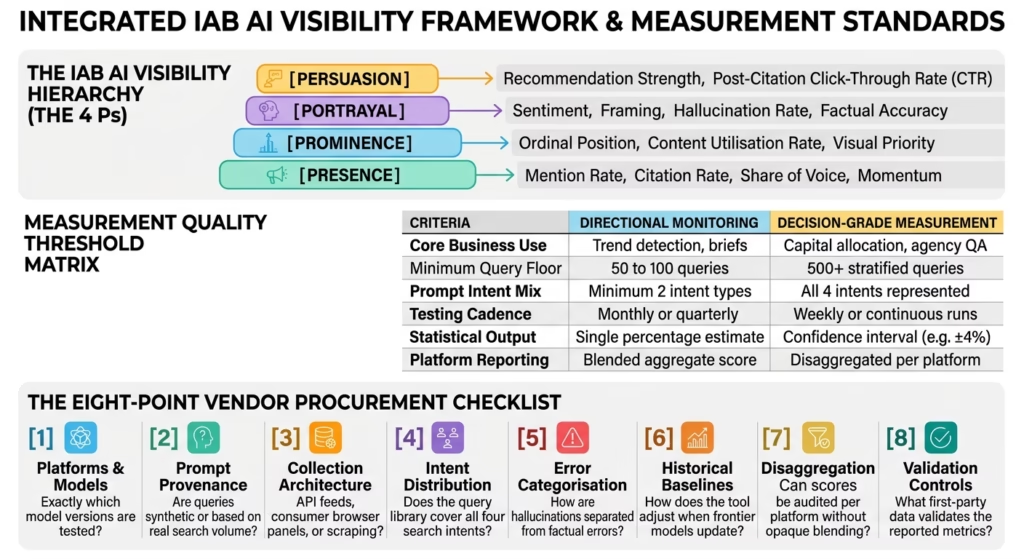
Use the IAB vendor disclosure requirements as a strict procurement filter.
- Which AI platforms and model checkpoints do you monitor? Insist on specific model versions rather than generic provider names.
- How is your prompt library constructed and refreshed? Clarify whether prompts are synthetic, drawn from live search volume, or captured from observed human panels.
- What data collection architecture do you run? Determine whether the software uses direct API calls, browser-level consumer rendering, or automated web scraping.
- How do you validate reported data? Require evidence of calibration against first-party analytics and verified conversion signals.
- How do you detect and report hallucinations versus factual inaccuracies? Confirm that flagged anomalies are displayed in an accessible audit log rather than quietly deleted.
- How do you handle model updates in your trend data? Demand to know whether baselines reset when major foundation models update.
- Do you provide disaggregated platform data? Reject proprietary blended indexes that hide performance variances behind a single arbitrary score.
- What compliance standards govern your collection? Verify that data gathering complies with EU data sovereignty, GDPR, and the EU AI Act.
If a measurement vendor refuses to answer these questions transparently, consider that silence an immediate operational warning.
Evaluating Market Tools Against the IAB Standard
No software vendor holds an official IAB endorsement or formal certification. Nevertheless, tools differentiate across methodology, platform scale, and data hygiene.
Enterprise Platforms Built for Governance
Enterprise tools like Profound capture consumer-rendered browser outputs across ChatGPT, Perplexity, Gemini, and Claude. This browser-rendered approach captures actual end-user experiences rather than isolated API text outputs. Its SOC 2 Type II validation satisfies enterprise governance standards. Similarly, Evertune conducts large query runs across multiple systems, providing the sample sizes needed to evaluate Portrayal metrics and brand attribute consistency.
Newer entrants like Peec AI, Scrunch AI, and AthenaHQ compete aggressively for mid-market budgets, offering varying levels of prompt transparency.
Traditional SEO Extensions
Established platforms like Semrush and Ahrefs have added AI brand monitoring to their suites. These tools benefit from extensive search query repositories. They are convenient for marketing teams that want traditional search and emerging AI tracking in a single interface. However, their prompt sampling can be narrower and their model coverage more limited than dedicated platforms.
Publisher Citation and Monetisation Engines
On the publisher side, platforms address monetisation and attribution. TollBit enables publishers to monitor AI scraper bots in real time, tracking access volume across individual pages to support commercial licensing discussions. ProRata operates an engine that licenses publisher content directly, sharing advertising revenue based on measured source contribution.
Simplified AI Visibility Framework (IDIRA® Framework)
Strategic Integration: Anchoring Visibility in the IDIRA Framework
Securing high brand visibility requires more than buying a monitoring dashboard. It requires structured internal data governance. Mid-market companies cannot afford disconnected tools.
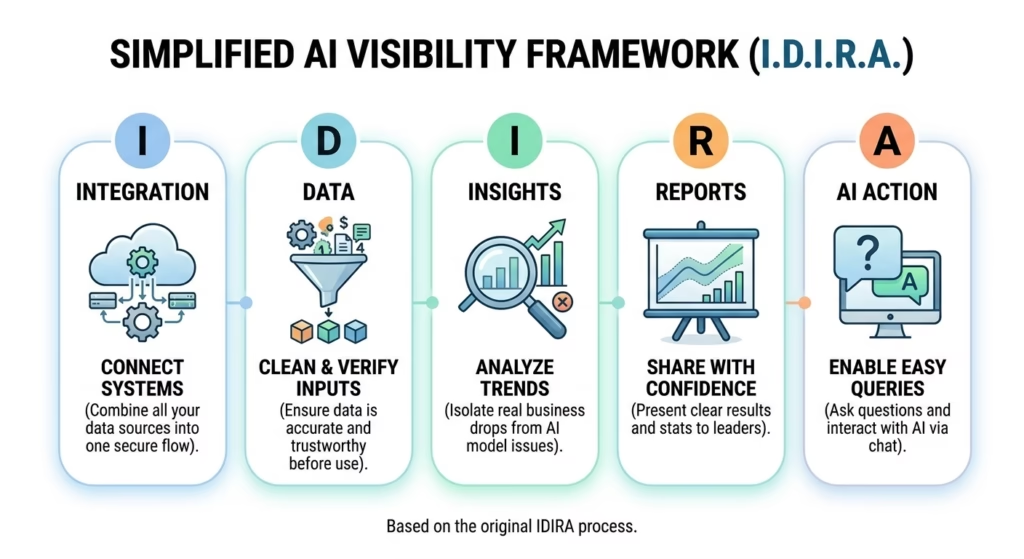
The proprietary IDIRA Framework, developed by Lisbon-based consultancy IT Tech BuZ, provides the operational model to turn visibility data into commercial growth.
- Integration: Break down organisational silos. Connect Google Analytics 4, CRM data, and advertising networks through enterprise-grade Model Context Protocol (MCP) servers.
- Data Collection: Capture clean first-party events. Comply with GDPR and the EU AI Act. Maintain sovereign control over your corporate data assets.
- Insights: Apply Bayesian thinking to visibility metrics. Distinguish platform-driven model updates from real market shifts. Prevent panicked reactions to routine model drift.
- Reports: Deliver executive clarity. Replace fragile single-number claims with statistical confidence bands that establish credibility with your CFO and board.
- Artificial Intelligence: Deploy conversational marketing intelligence through the conversational marketing analyst IDIRA.chat. Query your marketing database securely using plain language without exposing sensitive records to public LLM training pools.
In the B2B sector, trust remains the primary purchase driver. Research from Dentsu B2B indicates that feeling safe to sign a contract is the number one decision driver for three consecutive years. Furthermore, buyers reward organisations that make engagement simple: frictionless integration shortens sales cycles by 31%. By deploying structured measurement and governed AI systems, marketing leaders remove procedural friction and protect their organisation’s commercial standing.
Immediate Action Plan for This Quarter
Take three concrete actions this week:
- Stop presenting single-point visibility estimates to executive stakeholders. Demand confidence intervals from your analytics team to build trust with finance.
- Audit your measurement partners using the eight-question IAB procurement checklist. Identify whether your data is directional or decision-grade.
- Align your marketing operations with European data standards. Ensure your analytics and AI deployment comply with the EU AI Act and GDPR requirements.
To discover how your marketing organisation can master AI visibility measurement, explore our comprehensive IDIRA marketing framework training to upskill your team. For bespoke strategic guidance on deploying enterprise conversational analytics, contact the IT Tech BuZ advisory team to schedule an executive consultation.
Do not forget mandatory AI training to comply with the EU AI ACT; see our training EXECUTIVE TRAINING AI 2.0 Marketing
Frequently Asked Questions
What is AI visibility measurement?
AI visibility measurement evaluates how frequently, accurately, and prominently brands and publishers appear within answers generated by artificial intelligence search engines such as ChatGPT, Google Gemini, Claude, and Perplexity, using structured metrics such as Mention Rate, Citation Rate, and Sentiment.
What are the four Ps of the IAB AI visibility measurement framework?
The four Ps define a causal hierarchy for AI discovery. Presence measures if the brand appears. Prominence evaluates placement and utilization depth. Portrayal examines accuracy, sentiment, and hallucinations. Persuasion measures recommendation strength and click-through rates.
What is the difference between directional monitoring and decision-grade measurement?
Directional monitoring uses smaller prompt libraries (50 to 100 queries) on monthly intervals to spot broad trends. Decision-grade measurement requires large stratified query sets (500+ prompts), weekly runs, multi-platform disaggregation, and documented confidence intervals suitable for capital allocation.
How does the IAB framework distinguish between hallucinations and factual inaccuracies?
A hallucination occurs when an AI engine invents information or attributes claims to a source that never produced them. A factual inaccuracy occurs when the engine accurately cites external source material that itself contains erroneous data.
How does IT Tech BuZ ensure European data sovereignty with IDIRA.chat?
IDIRA.chat deploys within an organization’s private cloud or governed Model Context Protocol server. It accesses Google Analytics 4, CRM, and ad records securely using Bring Your Own Key architecture without exposing internal company data to public model training.
APA 7 Reference List
- CMO Alliance. (2026). CMO insights report 2026 (pp. 1-74). CMO Alliance & Webflow. [Open Access]
- Dentsu B2B. (2025). Fast, simple, trusted: How B2B brands win in the AI era (The Superpowers Index 5.0, 2025 ed.) (pp. 1-43). Dentsu International. [Open Access]
- Interactive Advertising Bureau. (2026, August 3). Measuring visibility in the AI era: Project Eidos industry framework (pp. 1-37). IAB. https://www.iab.com/ [Open Access]
- Interactive Advertising Bureau. (2025, November). AI personalization playbook: Briefing, building, benchmarking (pp. 1-34). IAB. https://www.iab.com/ [Open Access]
- Fishkin, R. (2025, October). State of search Q3 2025: Behaviors, trends, and clicks across the US & Europe (pp. 1-34). SparkToro & Datos. https://sparktoro.com/ [Open Access]
- Schumacher, K., Roberts, R., & Giebel, K. (2025, October). The agentic commerce opportunity: How AI agents are ushering in a new era for consumers and merchants (pp. 1-27). QuantumBlack, AI by McKinsey. https://www.mckinsey.com/ [Open Access]
- VML. (2025, July). The future shopper report 2025: Planet Earth first (9th ed.) (pp. 1-126). WPP / VML Enterprise Solutions. https://www.vml.com/ [Open Access]