

Executive Summary
- The CMO Execution Gap: BCG’s 2026 global survey of 300 CMOs reveals that while 96% claim AI is driving end-to-end transformation, 42% still use generative tools merely for discrete, ad-hoc assistant tasks.
- The Mandate Shift: Marketing now owns internal AI budgets in roughly 50% of enterprises, meaning CMOs carry direct accountability for measurable commercial growth and cost efficiency.
- The Structural Barrier: Individual prompts on desktop tools create fragmented data leaks rather than institutional assets. True corporate intelligence requires unified data infrastructure and server-side governance.
- The Architectural Fix: Deploying Anthropic’s Model Context Protocol (MCP) and the five-stage IDIRA Framework connects legacy silos, ad platforms, and CRM systems into governed agentic networks.
- Operational Sovereignty: European mid-market leaders must combine automated agent speed with GDPR, EU AI Act, and NIS2 compliance, turning data governance into a competitive trust moat.
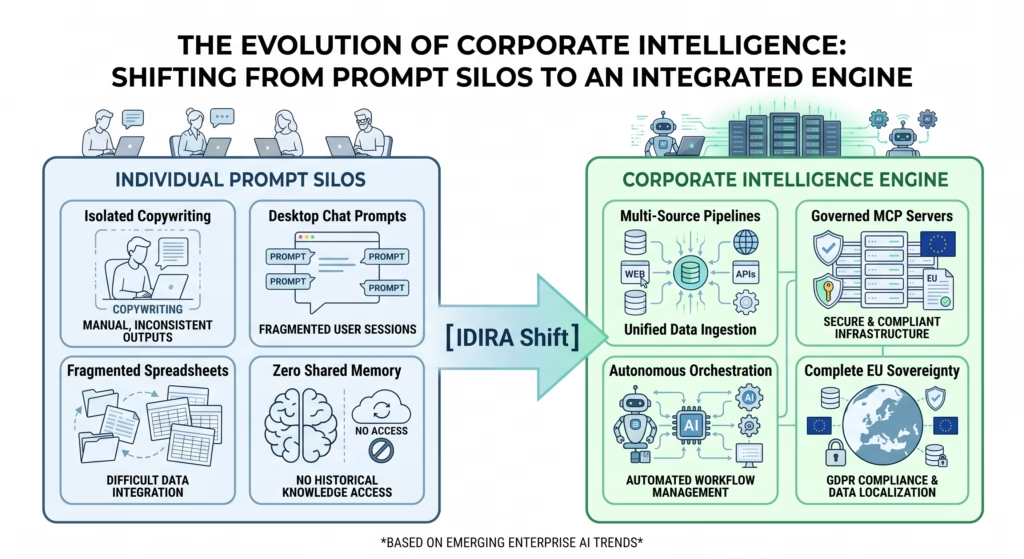
Your marketing department is likely running dozens of uncoordinated AI experiments today. Individual copywriters draft emails with ChatGPT; performance marketers generate ad copy variations in silos; junior analysts paste sensitive campaign figures into public web browsers to produce charts.
This ad-hoc activity creates the illusion of digital agility, but it produces zero persistent enterprise value. When a team member closes their browser tab, their context, learnings, and prompts vanish with them.
Every week your team relies on disconnected personal prompting, your organisation bleeds operational efficiency. You risk proprietary data exposure, and you fall behind competitors who are turning marketing workflows into systemic corporate assets.
The mandate has changed. Marketing leaders no longer need more personal productivity hacks; they need an institutional engine of intelligence.
What is the Reality Behind the 2026 CMO Survey?
Boston Consulting Group’s report, Making the Agentic Marketing Transformation a Reality, reveals a stark divide. Nearly every marketing executive surveyed, 96%, states that AI is driving end-to-end transformation across their function. Yet beneath that claim lies an uncomfortable reality: 42% admit they still use generative AI purely as an assistant for discrete, isolated tasks.
Only 32% have built multi-workflow agentic systems, and a mere 8% orchestrate autonomous multi-agent campaigns.
This disconnect marks the defining tension of marketing leadership today. Marketing has won the mandate to lead corporate AI investment, with roughly 50% of CMOs now controlling AI budgets within their departments, compared to 14% guided by boards and 15% led by central strategy.
Because marketing controls the budget, the burden of commercial proof lands squarely on the CMO. The board no longer celebrates basic time-saving experiments. They demand proof of marketing contribution, shorter sales cycles, and demonstrable margin growth.
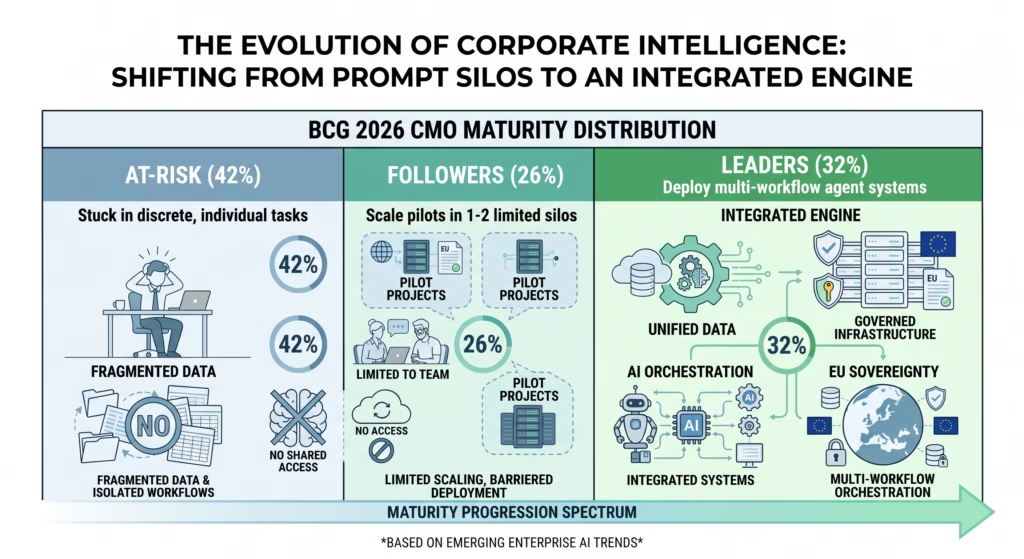
Why do 42% of marketing teams remain stuck? Because individual contribution cannot fix a broken operating model. Adding AI tools on top of disconnected platforms only accelerates chaos.
According to the Dentsu B2B Superpowers Index, ease and dependability are now the primary drivers of commercial success, shortening business deal cycles by up to 31%.
When your data remains fragmented across Google Analytics 4, CRM platforms, and advertising channels, your team spends 80% of their working hours hunting for numbers instead of executing strategy.
Why Must Marketing Move Beyond Individual Prompts?
Individual AI usage creates tactical wins, but corporate intelligence builds structural advantages.
When an employee prompts a public model to summarise a campaign, that interaction is ephemeral. The logic remains trapped in that employee’s head, and the corporate entity gains no shared memory, no repeatable protocol, and no proprietary training data.
Corporate intelligence means building a unified knowledge engine where marketing systems, data pipelines, and intelligent agents interact continuously.
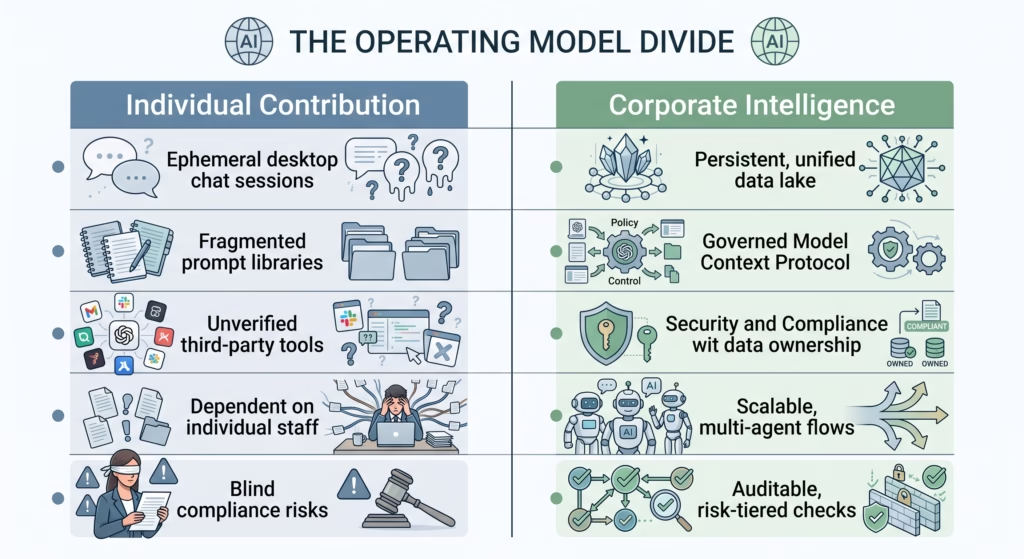
Consider the legal exposure. Under the EU AI Act and GDPR, pasting customer identifiers, unverified lead lists, or confidential financials into unvetted public models breaches fundamental data sovereignty rules.
Mid-market European organisations cannot afford regulatory fines or reputational damage. McKinsey’s 2025 analysis on agentic commerce notes that trust is foundational infrastructure; without cryptographically verifiable mandates and strict data boundaries, scaling autonomous systems is impossible.
Corporate intelligence solves this by centralising data assets behind governed, private architectures. Instead of relying on individual staff members to query dashboards, the organisation implements structured protocols in which authorised models securely converse with first-party data.
How Does the IDIRA Framework Structure Agentic Systems?
To transform individual experimentation into enterprise capability, IT Tech BuZ deploys its proprietary IDIRA Marketing Framework. Created to bridge the gap between technical data engineering and executive decision-making, IDIRA organises the agentic transformation across five progressive stages:
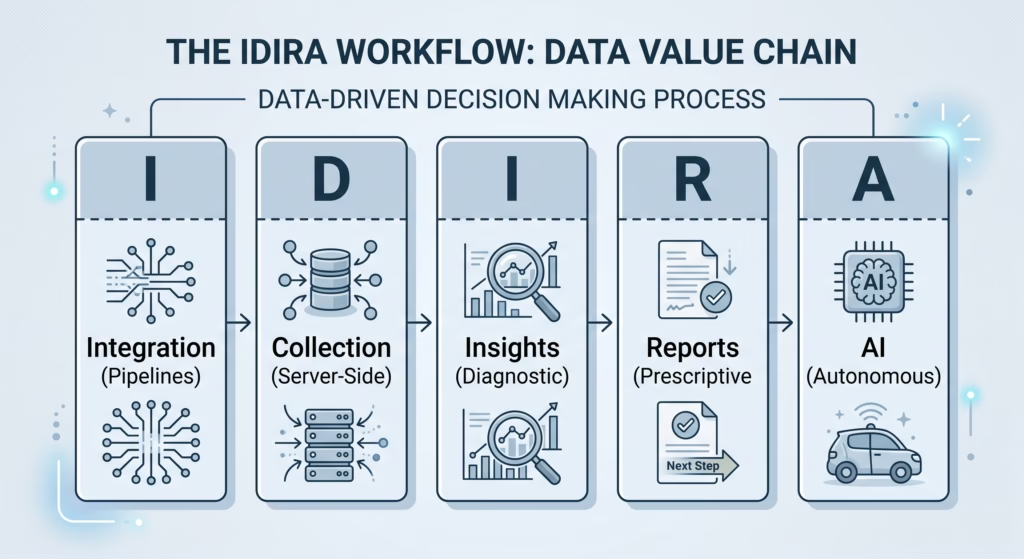
1. Integration of Data Sources
You cannot deploy agentic AI onto fragmented infrastructure. The first pillar connects your primary platforms, including Google Analytics 4, Meta Ads, Google Ads, and CRM platforms like HubSpot or Salesforce, into a single repository.
Using Anthropic’s Model Context Protocol (MCP), your enterprise creates a translation layer between models and live data sources. The MCP server securely connects language models to verified internal databases without moving data into public clouds.
2. Data Collection
Clean outputs require pristine inputs. This phase replaces fragile browser-based trackers with resilient, server-side tagging architectures.
Server-side collection ensures complete data hygiene, preserves cookie-less attribution accuracy, and complies with EU privacy mandates. High-granularity event logging feeds verified business facts into your agentic systems.
3. Insights
Raw data is an expense; actionable insight is an asset. In this stage, diagnostic models evaluate performance across channels simultaneously.
Instead of waiting for an end-of-month review, the system flags performance anomalies, cost-per-acquisition spikes, and drop-off points in real time.
4. Reports
Static PDF reports and cluttered dashboards fail to drive action. Research shows that 53% of business leaders believe flashy digital features add zero value when basic functionality remains poor.
The Reporting layer transforms complex multi-channel numbers into concise, executive-level answers, accessible on demand.
5. Artificial Intelligence
The final stage activates agentic capability. Armed with integrated, server-side data, autonomous systems execute predictive and prescriptive workflows.
This is where the IDIRA.chat conversational marketing analyst operates, letting CMOs and marketing directors query complex enterprise metrics in natural language.
How Does IDIRA.chat Operationalise Enterprise Intelligence?
IDIRA.chat is not a generic wrapper for public chatbots. It is a dedicated conversational marketing analyst built specifically for mid-market organisations requiring fast answers with strict data sovereignty.
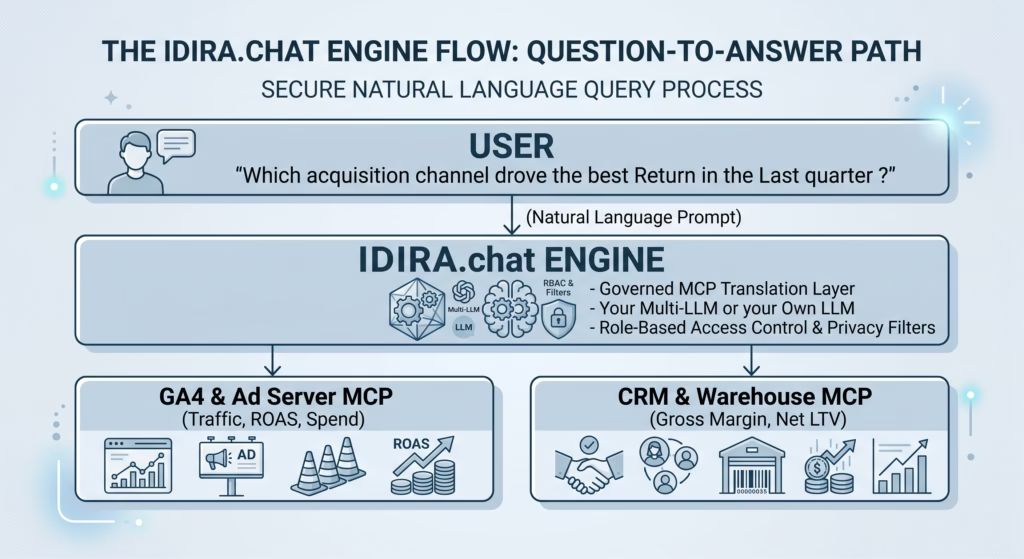
Traditional analytics tools demand complex SQL queries, manual data exports, or hours spent navigating nested user interfaces. When a CEO asks for campaign returns, a marketing director often needs two days to stitch spreadsheets together.
IDIRA.chat eliminates that delay entirely. By integrating directly with your data stack through secure MCP connections, it allows leaders to ask plain-language questions:
“Compare our customer acquisition costs between Meta and Google Ads for the German market over the last 90 days. Factor in returned orders from our CRM, and show the true net margin.”
Within seconds, the platform interrogates the underlying sources, reconciles the discrepancies, and delivers an auditable answer.
It does not train public models on your confidential metrics. Your data stays entirely within governed European servers, guaranteeing full compliance with GDPR and the EU AI Act.
By removing the manual reporting bottleneck, your team reclaims ten to fifteen hours per person every week.
Case Study: Reallocating Multi-Channel Spend in Real Time
To understand the difference between individual contribution and corporate intelligence, examine the operational reality of an omnichannel enterprise.
- The Organisation: A European consumer brand operating across four regional markets with direct-to-consumer digital channels and wholesale retail distribution.
- The Problem: The marketing team consisted of six specialists, each using separate AI copywriting and spreadsheet tools. Performance data was siloed across GA4, Shopify, and local ad accounts. Weekly reporting took eighteen hours of manual labour, and channel budget reallocations were conducted monthly, resulting in wasted ad spend on underperforming campaigns.
- The Intervention: In late 2025, the brand deployed the five-stage IDIRA Framework. Data pipelines were centralized into a secure Google BigQuery environment. Server-side tagging was configured to eliminate data loss, and IDIRA.chat was introduced as the team’s conversational intelligence interface.
- The Measured Result: Reporting preparation time dropped from eighteen hours to under fifteen minutes weekly. Within forty-five days, IDIRA.chat identified a 22% discrepancy between reported platform ROAS and actual bank-settled profit on ad spend (POAS), caused by unrecorded return rates in their CRM. Reallocating budget away from low-margin campaigns generated a 19% improvement in overall marketing contribution margin.
What are the Three Pillars of Sustainable AI Marketing ROI?
To ensure your agentic marketing transformation delivers enduring balance-sheet value, focus your resources on three core pillars
PILLARS OF SUSTAINABLE ROI
1. DATA SOVEREIGNTY & COMPLIANCE
– Full alignment with GDPR, EU AI Act, and NIS2
– Your infrastructure and your data
2. BEHAVIOURAL FRICTION REDUCTION
– Strip manual steps from daily employee reporting
– Drive buyability through verified answer delivery
3. HUMAN-IN-THE-LOOP QUALITY GATES
– Clear error tiering for automated vs human approvals
– Brand guardianship embedded into prompt architecture
1. Data Sovereignty and Compliance
Data privacy is not an administrative chore; it is your strongest competitive asset. As public platforms face increasing regulatory scrutiny, brands that guarantee client confidentiality build superior commercial trust.
Deploying private models using your own API keys ensures your intellectual property remains yours.
2. Behavioural Friction Reduction
The Dentsu Superpowers Index establishes that ease is the new edge. When internal systems are difficult to use, adoption plummets.
According to MIT research, 95% of enterprise AI pilots fail to show positive ROI because workflows do not integrate with daily operational habits. By adopting conversational interfaces, you reduce the effort needed to make data-backed decisions to zero.
3. Human-in-the-Loop Quality Gates
Agentic systems must never run without clear boundaries. As outlined in the IAB AI Personalization Playbook, organisations need risk-tiered governance.
Low-risk outputs, like formatting ad variations, can run automatically under system logging. High-risk actions, including public claims, budget reallocation thresholds, and legal disclaimers, must require explicit human sign-off.
Conclusions and Your Action Plan for This Week
The transition from isolated prompts to corporate intelligence is no longer optional. Marketing teams that master this shift will dominate market share, while those trapped in task-level experimentation will struggle with declining margins and mounting board pressure.
Take these concrete actions to begin your transition:
- Audit Your Prompting Fragmentation: Conduct an internal inventory of all third-party AI tools currently used by your team. Identify where company data is being shared without central oversight.
- Eliminate Your Reporting Bottlenecks: Map the exact hours your analysts spend pulling reports manually from GA4, ad managers, and CRMs. Quantify the financial cost of that lost time.
- Establish a Sovereign Data Layer: Transition away from fragile client-side scripts to secure, server-side data collection that feeds your core business metrics into a single private repository.
- Deploy a Conversational Analytics Pilot: Introduce a private conversational interface like IDIRA.chat across one critical workflow, such as weekly acquisition spend analysis.
- Upskill Your Core Team: Equip your marketing managers with structured strategic training. Enrol your leadership in executive training on the IDIRA Framework to master the principles of data-driven intelligence.
Ready to transform your data into corporate intelligence? Contact the IT Tech BuZ advisory team today to schedule your discovery consultation.
Frequently Asked Questions
What is agentic marketing transformation?
Agentic marketing transformation is the shift from manual human execution and isolated AI prompting to autonomous, multi-agent systems that connect data pipelines, automate strategic workflows, and execute customer journeys with human oversight.
Why is the CMO execution gap significant according to BCG?
BCG’s 2026 research indicates that while 96% of CMOs claim AI is transforming their function, 42% still use generative tools solely for discrete assistant tasks. Closing this gap is critical because marketing now controls approximately 50% of departmental AI budgets and must demonstrate tangible commercial ROI.
How does the IDIRA framework support agentic AI in marketing?
The IDIRA framework organizes data maturity across five stages: Integration, Data Collection, Insights, Reports, and Artificial Intelligence. It eliminates data silos, introduces server-side tracking, and deploys conversational AI agents like IDIRA.chat to deliver governed decision-making.
How does IDIRA.chat protect EU data sovereignty under GDPR and the EU AI Act?
IDIRA.chat utilizes the Model Context Protocol (MCP) and secure, private European hosting environments. It allows enterprises to query sensitive marketing and CRM data using natural language without exposing proprietary information to public model training datasets.
What is the difference between individual AI contribution and corporate intelligence?
Individual contribution involves employees using isolated AI chat sessions for personal productivity, leaving context trapped in browser tabs. Corporate intelligence builds a connected knowledge layer with unified first-party data, persistent organizational memory, and governed agent workflows.
APA 7 Reference List
- Boston Consulting Group. (2026, June 15). Making the agentic marketing transformation a reality. BCG Publications. https://www.bcg.com/publications/2026/making-the-agentic-marketing-transformation-a-reality
- Dentsu B2B. (2025). The superpowers index 5.0: Fast, simple, trusted: How B2B brands win in the AI era. Dentsu International. https://www.dentsu.com
- Interactive Advertising Bureau. (2025, November). AI personalization playbook: Strategic frameworks for briefing, building, and benchmarking at scale. IAB. https://www.iab.com
- McKinsey & Company, & QuantumBlack. (2025, October 17). The agentic commerce opportunity: How AI agents are ushering in a new era for consumers and merchants. McKinsey Digital. https://www.mckinsey.com/capabilities/quantumblack/our-insights/the-agentic-commerce-opportunity-how-ai-agents-are-ushering-in-a-new-era-for-consumers-and-merchants
- Schumacher, K., Roberts, R., & Giebel, K. (2025). Navigating trust and risk in agent-mediated enterprise transactions. QuantumBlack AI Insights.
- VML. (2025, June). The future shopper report 2025: Omnichannel dynamics and the emergence of algorithmic commerce (9th ed.). VML Enterprise Solutions. https://www.vml.com