
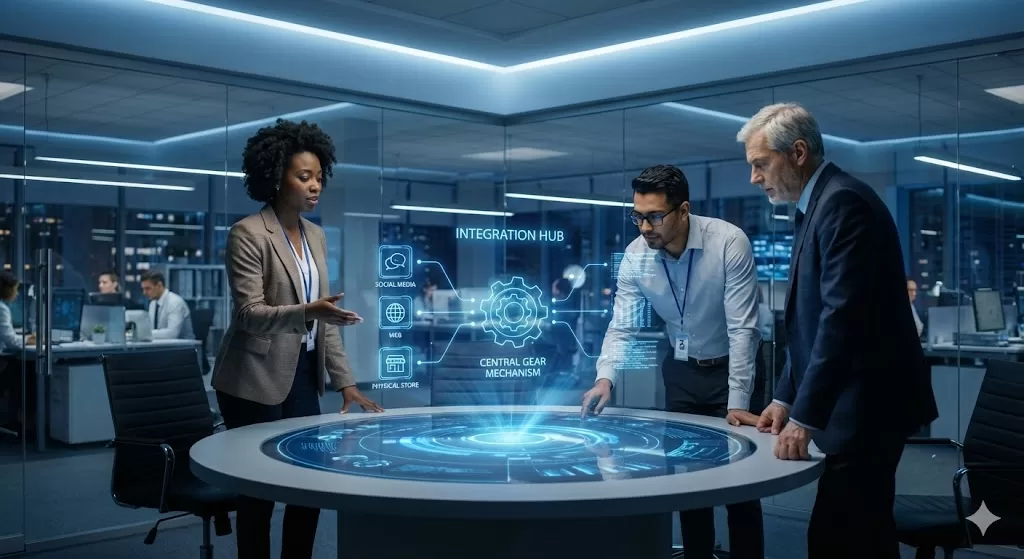
Omnichannel Integration Strategy: Unifying the Customer Journey with AI
Executive Summary
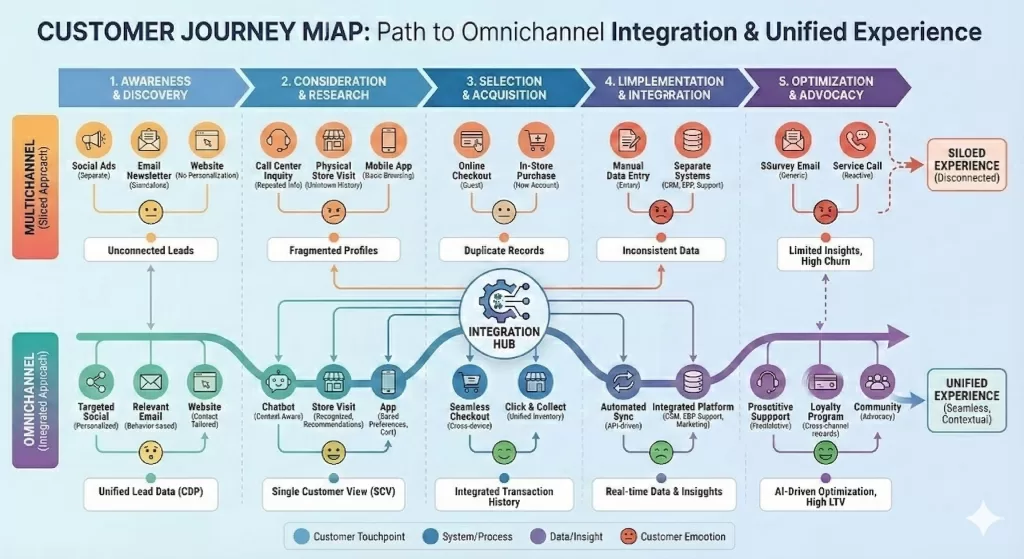
The modern customer journey is no longer linear; it is a complex web of touchpoints that demands immediacy and relevance. As depicted in the Customer Journey Map analysis, organisations often suffer from a “Siloed Approach,” characterized by unconnected leads, inconsistent data, and high churn. The transition to an “Integrated Approach” is not merely a technical upgrade; it is a strategic imperative for survival. By establishing a central Integration Hub, businesses can move from reactive service calls to proactive, AI-driven optimization. This article outlines how to lower the effort required to unify your data, connect emotionally with buyer needs, and deploy smart prompts to guide the journey, ensuring your brand delivers the speed and ease that modern buyers demand.
The Cost of Disconnection: Why Silos Kill Growth
In the current digital landscape, the “Multichannel” approach shown in the journey map represents a critical risk. When social ads, email newsletters, and website interactions operate in isolation, the result is fragmented profiles and duplicate records. This friction increases the cognitive load on the buyer. According to the CMO Survey 2025, marketing leaders struggle to demonstrate the impact of marketing actions on financial outcomes due to this very fragmentation.
For a buyer, this disconnection manifests as frustration. If a potential client engages with a call center inquiry but has to repeat information already provided via a web form, trust erodes. The Dentsu Superpowers Index 2025 highlights that “ease is the new edge,” with winning brands making it significantly easier for buyers to navigate the purchase process. To stop losing high-value leads to operational inefficiency, businesses must dismantle these silos.
The Integration Hub: Implementing the IDIRA Framework
To transition from the red zone of “Siloed Experience” to the green zone of “Unified Experience” (as visualized in the diagram), organisations must implement a robust Integration Hub. This aligns perfectly with the IDIRA framework methodology (Integration, Data Collection, Insights, Reports, Artificial Intelligence) championed by IT Tech BuZ:
- Integration: The core gear of the system. This involves connecting CRM, ERP, and Support systems via APIs to ensure a seamless flow of data.
- Data Collection: Moving from “Manual Data Entry” (prone to errors) to “Automated Sync.” This ensures that when a lead engages via a mobile app or a physical store visit, the data is captured instantly and accurately.
- Insights: Converting raw data into a “Single Customer View (SCV).” This allows for predictive support rather than reactive firefighting.
- Reports: Utilizing dashboards to visualize cross-channel performance, moving beyond “Limited Insights” to actionable intelligence.
- Artificial Intelligence: Deploying AI not just for content generation, but for orchestration. As noted in McKinsey’s Agentic Commerce report, AI agents will soon navigate these ecosystems on behalf of buyers, necessitating a technical infrastructure that is agent-ready.
You can explore more about how we structure this data integration at IT Tech BuZ Services.
3. From Transaction to Relationship: The Role of AI and IDIRA.chat
The journey map illustrates the ultimate goal: Optimization & Advocacy. This stage relies heavily on AI-Driven Optimization to increase Customer Lifetime Value (LTV). By integrating tools like IDIRA.chat, businesses can offer a conversational interface that accesses the “Integration Hub” to provide instant, context-aware answers to internal teams or customers.
McKinsey predicts that by 2030, agentic commerce could drive trillions in orchestrated revenue. To capture this, your marketing stack must be capable of “Contextual AI-driven personalization,” where an AI agent can recall past interactions (e.g., a store visit or a previous cart) and suggest the next best action. This shifts the dynamic from a transactional exchange to a continuous, value-added relationship.+1
Building Trust Through Consistency
The Dentsu Superpowers Index reveals that “trust” remains the number one decision driver for B2B buyers. A unified experience fosters trust because it is predictable. When a customer receives a “Relevant Email” based on behavior rather than a “Generic Survey,” they feel understood.
Framing your message around safety and success is crucial. By securing data through a unified Lead Data (CDP) system, you assure clients that their information is protected and used to enhance their success, not just to sell to them. This emotional relevance fuels comprehension and drives the action to purchase or renew.
Conclusion: Lowering the Threshold for Action
Achieving an omnichannel integration strategy does not require an overnight overhaul. Start by identifying the points of highest friction in your current customer journey map. Is it the handoff from marketing to sales? Is it the disconnect between online checkout and in-store history?
Lower the threshold for action by focusing on one key integration point. Use smart prompts to guide your internal teams toward data unity. The easier it feels for your customer to buy, the faster they will do so. By adopting the IDIRA framework, you ensure your infrastructure is robust enough to support the AI-driven future of B2B and B2C commerce.
Make your marketing campaigns achieve higher results through Data-Driven Results. Marketing Strategy on Digital Assets.
Frequently Asked Questions (FAQ)
- What is the difference between multichannel and omnichannel marketing? Multichannel marketing uses multiple channels (social, web, email) that operate independently, often leading to siloed data. Omnichannel marketing integrates these channels into a single ecosystem, ensuring data flows freely to create a unified customer experience, as shown in the journey map.
- How does the IDIRA framework support omnichannel integration? The IDIRA framework (Integration, Data Collection, Insights, Reports, AI) provides a structured methodology to centralise data. It ensures that data collected from various touchpoints is integrated, analysed for insights, reported accurately, and leveraged by AI to optimize the customer journey.
- Why is an Integration Hub essential for marketing? An Integration Hub acts as the central nervous system of your marketing stack. It eliminates manual data entry errors, resolves duplicate records, and creates a Single Customer View (SCV), which is essential for accurate targeting and account-based marketing.
- How will Agentic AI impact customer journey mapping? Agentic AI will evolve customer journeys from static paths to dynamic interactions. AI agents will act on behalf of buyers to negotiate, purchase, and schedule services. A unified data infrastructure is required for these agents to function effectively within your ecosystem.
- What are the primary benefits of a unified customer experience? A unified experience leads to higher Customer Lifetime Value (LTV), increased advocacy, and lower churn. It builds trust by ensuring consistency across all touchpoints, which is the primary driver for B2B purchasing decisions.