
Conversational AI in marketing: Compare generalist, suite, and specialised AI.
The essentials
- The right question is not which tool. It is whether you can defend the answer in a board meeting.
- Intelligence lives in different places. In the model, in the platform or in the marketing domain, each with a right use and a clear limit.
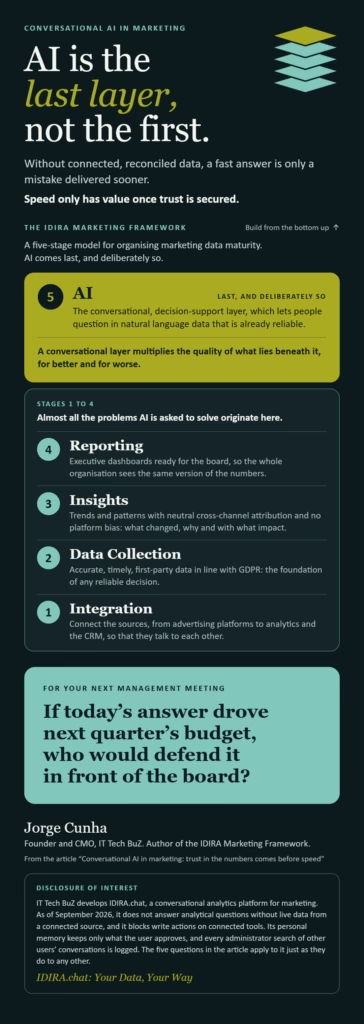
- AI is the last layer, not the first. Without connected, reconciled data, a fast answer is only a mistake delivered sooner.
The most dangerous answer is the one that looks right
An AI assistant answers in seconds, in well-built sentences and with total confidence. The problem is not the speed. It is that, in marketing, a fluent but wrong answer costs more than a slow, correct one.
Picture Monday’s meeting. Meta Ads and Google Ads each claim the same sale. The sum of reported conversions exceeds actual orders, and the finance director asks where the number comes from. If the answer came from a tool nobody can explain, the problem is no longer technical: it has become one of credibility.
That is why choosing a conversational AI tool for marketing should not start with the question “which is the best?”. It should start with another: what data does the answer rest on, and can I defend it? The thesis of this article is simple: conversational AI is the last layer of a good marketing data architecture, not the first. Speed only has value once trust is secured.
Where the intelligence lives: three approaches
When a team says it wants to use AI with its marketing data, it is choosing, often without realising it, where the intelligence lives. There are three possible answers, each with a right use and a clear limit.
| Approach | Shines at | Falls short at | Choose it when |
|---|---|---|---|
| In the model: general-purpose AI (ChatGPT, Claude, Gemini) | Content, strategy, synthesis and individual productivity. | Access to company data without its own integrations and governance. | The work is creative or planning-led, not about reconciled numbers. |
| In the platform: embedded AI (Microsoft Copilot, Salesforce Agentforce, HubSpot Breeze, assistants on Power BI, Looker and Tableau) | Simple access to the ecosystem’s data and integration into existing workflows. | Data outside the platform. Analytical depth varies widely between vendors. | The company already lives on that platform and its processes are well defined. |
| In the domain: AI native to marketing analytics (a younger, more fragmented segment) | Campaigns, attribution, conversions and budget, in the language of marketing and with less technical dependence. | Tasks outside the analytical domain. Value depends on the data and integrations available. | The priority is to cut analysis time and consolidate marketing data. |
None of the three is best in the abstract. Each solves a different problem, and many organisations will end up using more than one.
Five questions before deciding
Whatever the approach, these five questions separate a convincing demo from a tool the board can trust. Each has a warning sign: if the vendor hesitates, you already have your answer.
- Does it reach the data that matters? CRM, Google Analytics, advertising platforms, sales and financial data. Without the right data, no AI produces relevant insights. Warning sign: the tool answers confidently about sources it cannot access.
- Can it tell fact from estimate? Real data, inferences, estimates and tracking inconsistencies cannot reach the decision-maker with the same tone of certainty. Warning sign: no answer states its source, its confidence level or the limits of what it claims.
- Where is my data and who can access it? In Europe, GDPR, access control and the use of company data are board-level issues, not just IT ones. That includes the conversations themselves: who can read what your team asks, and is that access recorded? Depending on sector and company size, NIS2 and the transparency rules of the AI Act may also apply. Some vendors make this part of their value proposition. One is IDIRA.chat, from the author’s company, which highlights the tagline “Your Data, Your Way”. Warning sign: the vendor cannot say, in writing, where data is processed, by whom and with what access log.
- Will my team actually use it? A powerful tool that demands advanced analytics or data engineering skills often ends up barely used. Warning sign: only two or three people can get value from it.
- How long until it produces the first better decision? The most sophisticated solution is not always the best one. For many teams, answering everyday questions quickly is worth more than a complex system that takes months to implement. Warning sign: the implementation plan talks about quarters before it talks about decisions.
Order matters: AI is the last layer
In the IDIRA Marketing Framework, a five-stage model for organising marketing data maturity, AI comes last, and deliberately so.
- Integration. Connect the sources, from advertising platforms to analytics and the CRM, so that they talk to each other.
- Data Collection. Collect accurate, timely data on a first-party basis and in line with GDPR: the foundation of any reliable decision.
- Insights. Analyse the data to find trends and patterns, with neutral cross-channel attribution and no platform bias: what changed, why and with what impact.
- Reporting. Present results clearly, in executive dashboards ready for the board, so that the whole organisation sees the same version of the numbers.
- AI. The conversational, decision-support layer, which lets people question in natural language data that is already reliable.
Almost all the problems AI is asked to solve originate in the first four stages. A conversational layer multiplies the quality of what lies beneath it, for better and for worse.
A portfolio, not a winner
If no approach is best in the abstract, the useful question for a board changes. It stops being “which tool do we buy?” and becomes “which tool serves each type of decision?”. A general-purpose AI for content and planning, the AI of the platform where the team already works and, for performance and budget, a layer built on reconciled marketing data can coexist, as long as each has its place.
A portfolio only works with clear rules. Four governance decisions help avoid the most common problems:
- Which data each tool can see. Define it by tool, by source and by role, rather than letting connections pile up through individual initiative.
- What verifiable trail sits behind answers that move budget. If an answer justifies investing more or less in a channel, it must be possible to trace where it came from: which sources were queried and which model wrote it.
- Who approves new data connections. Every new source adds risk and a new possibility of inconsistency.
- What the tool is allowed to remember. An assistant that remembers between conversations can carry a wrong assumption forward for months. Let it keep definitions, such as what counts as a conversion in your company, but never figures, and have a person approve what is stored.
The Monday test
On Monday, before any vendor demo, run a test that costs almost nothing. Pick five questions your team asks every week, for example “which campaigns brought the most sales?” or “where are we spending without return?”. For each one, note which sources it needs, how long it takes to get the answer today and who in the company can validate it.
Then put each tool to the test with the same five questions and compare three things: whether it reached the right sources, whether it separated fact from estimate and whether the answer would survive a board meeting.
The result tells you more about the right choice than any feature comparison. It also shows what is still to be fixed in your data.
For your next management meeting:
if today’s answer drove next quarter’s budget, who would defend it in front of the board?
About the author
Jorge Cunha is the founder and CMO of IT Tech BuZ, a digital analytics consultancy since 2012. He has more than 15 years of experience in analytics and digital marketing, has been Google Analytics certified since 2010 (renewed in 2023) and lectures at IPAM, the University of Coimbra and ISLA. He is the author of the IDIRA Marketing Framework.
Disclosure of interest. IT Tech BuZ develops IDIRA.chat, a conversational analytics platform for marketing that falls under the third approach described in this article. As of September 2026, it does not answer analytical questions without live data from a connected source, and it blocks write actions on connected tools. Its personal memory keeps only what the user approves, and every administrator search of other users’ conversations is logged. The five questions above apply to it just as they do to any other.
Download the infographic: